When Stephanie invited me to share her Indio Dye vat, I went right to my bin of vintage hankies and pulled out the white ones edged in lace.
(You can read about my day dyeing with Indigo at Stephanies here)
First I had to scour the hankies so the dye would take. I cooked them in water and Dawn dish detergent.
Some I folded and tied with rubberbands to get a Shibori-like design, others I just left plain.
At Stephanie’s, the next day, I soaked them in the Indigo dye vat for 3 minutes. Then I rinsed them in water and hung them on the line.
When the hankies first come out of the dye they are green. It’s only when they hit the air, that turn blue.
My folded and tied hankies on the line.
After dyeing and rinsing the hankies had to hang on the line for at least 15 minutes. Then the whole process begins again.
I had about 20 plain hankies and 12 folded hankies.I dyed my hankies five or six times (I lost count).
I was excited to unfold the hankies I’d tied to see what they looked like. I got some nice designs, but I’m still not done. Now I have to wash the hankies in ivory soap until all the indigo dye comes out of it. They will be two shades lighter once they are washed.
I’m not sure if I’ll make scarves out of the hankies or a quilt or maybe use them in a little of both.
Today I pulled the hankies that I dyed in the workshop at the Cambridge Historical Society the summer before last and the stack draped over the dining room chair since July and got to work.
I think it’s the cool weather, I find myself wrapping the Vintage Hankie Scarf I made years ago around my neck. A thin scarf, just enough too keep my neck warm and look good too.
I was also looking for something different to do in my studio.
I grated the soap (so much like cheddar cheese) while boiling a teapot of water. The soap needs to be melted and it seemed the best way to make that happen.
Wash then rinse and rinse and rinse again and again and again….
…until the water runs clear.
At least nine rinses in hot water Stephanie told me. And for the hankies that I folded and wrapped with rubber bands, I rinsed them exactly nine times. But the hankies that were a solid indigo, it took fourteen rinses.
Two and half hours later, my back hurting more from standing at the sink than from moving hay, I put the hankies in the washing machine to spin.
As they dried under my iron they changed color once again. Sometimes the dye picking up the weave of the fabric.
The lace varied in color depending on the fiber it was made from.
As they dried the subtitles and deep contrasts were revealed.
The linens took the dye more softly, mottled, suede-like.
I truly believed at the start of the day that I’d rinse all the hankies and being sewing them together to make some scarves. But by the time I got done, it was late afternoon. Too late for my brain switch and be creative.
But after doing some shipping and feeding the animals, I did go back to my studio just to look at the Indigo hankies laid out on my floor.
Even now, looking at my picture of them all together, makes my mind hum….
Susannah’s Natural Dyeing Display at the Cambridge Farmers Market
I saw Adina and her spinning wheel as soon as we got to the Farmer’s Market. The tent was like a magnet pulling at me.
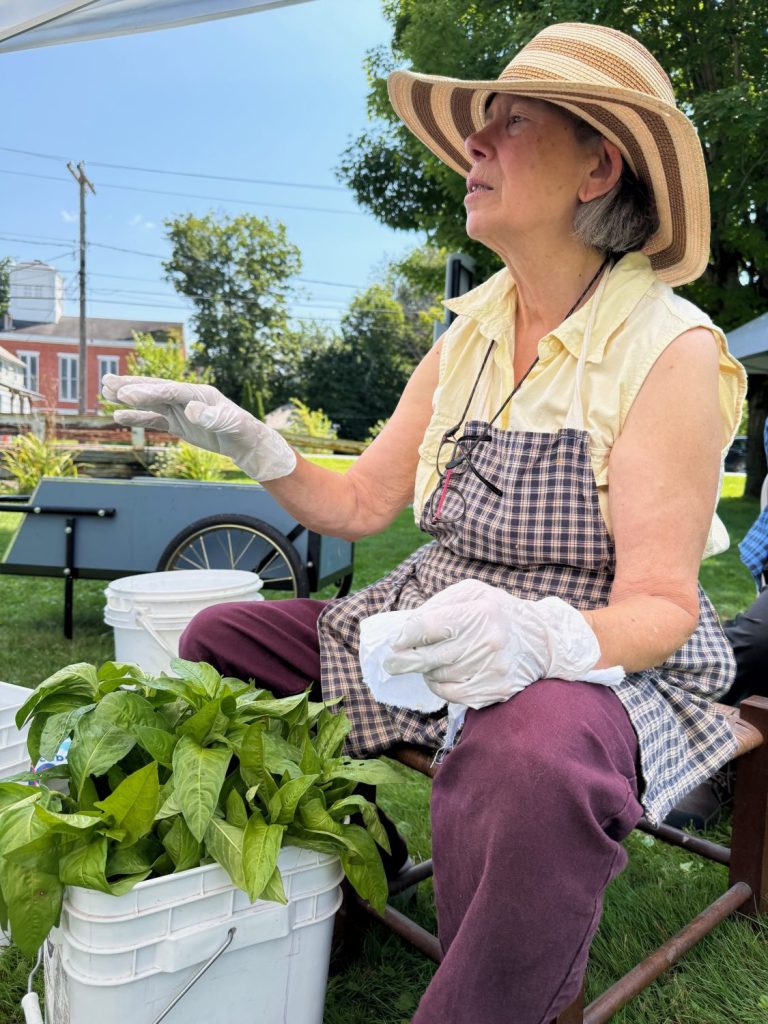
Susannah White, was sitting on a low bench with a bucket of freshly cut indigo plants next to her. She had picked them from her garden that morning.
I’ve been thinking of Susannah since I met her again at Stephanie Morton’s house a few weeks ago where we were dying with Indigo. Stephanie dyes with dried indigo, which is different than dying with fresh indigo which Susannah was doing today.
That weekend Susannah and I talked sheep. Although Susannah no longer has sheep, she still works with wool, specifically Border Leicester. She hand cleans and cards it, dyes it naturally, and felts it to make into puppets.
When Susannah told me how she loves the sheen of Border Leicester wool, I thought of the bag of wool I have from my ewe Socks. Socks died just before shearing and her wool was so beautiful, I cut some off of her before putting her body in the field for other animals to eat.
Susannah and her home grown indigo in a bucket of ice water to help keep it from oxidizing.
So I went home and came back with the bag of Socks’ wool to give to Susannah.
When I got there, the tent was full of kids and their parents rolling a small piece of cotton fabric, filled with indigo leaves, between their hands.
I got a piece of cotton fabric and joined them.
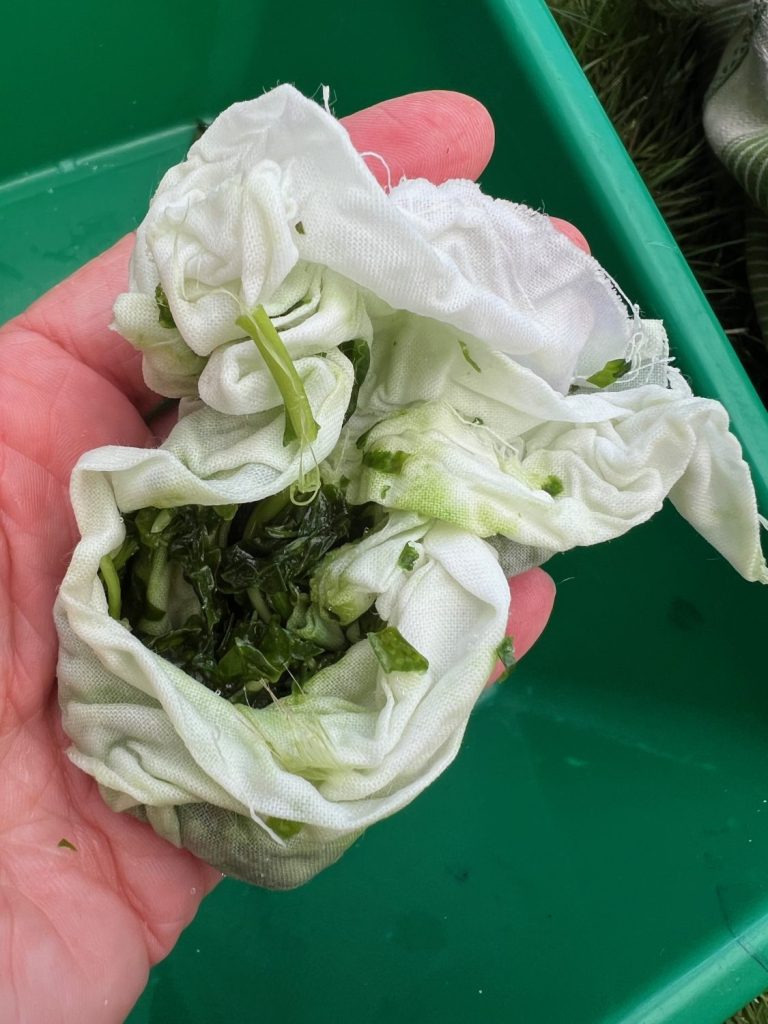
The indigo leaves in my cotton cloth
The cells of the indigo leaves are filled with two different chemicals (? I’m not sure that’s the right word) and the two different cells have to be broken and mixed together to create the indigo color dye.
First we twisted the leaves, the then broke them into small pieces. We put the pieces into the wet cloth, added a little salt to speed the process up, and rolled and squeezed them in our hands and watched the white cloth turn green.
There is little consistency dying this way. Each leaf may produce a different color. The color also depends on how well the plants grew. This spring and summer were difficult ones for indigo, with widely varying temperatures, then a period of intense heat.
As soon as the plants are cut they begin to oxidize and turn indigo blue. Unless you put them in ice water which slows the process. If the plants turn blue before they come in contact with the fabric, the dye won’t work.
Each piece of fabric was a different color depending on the leaves, how much pressure we applied and how long we worked it.
Susannah not only knows all about natural fibers and dyes, she knows and shares the history of it.
There are lots of varieties of indigo plants. The ones Susannah grows originally came from Africa. In the United States, the knowledge as well as the labor of growing and processing Indigo into dye, came from enslaved African’s. For many years it was one of the country’s largest export.
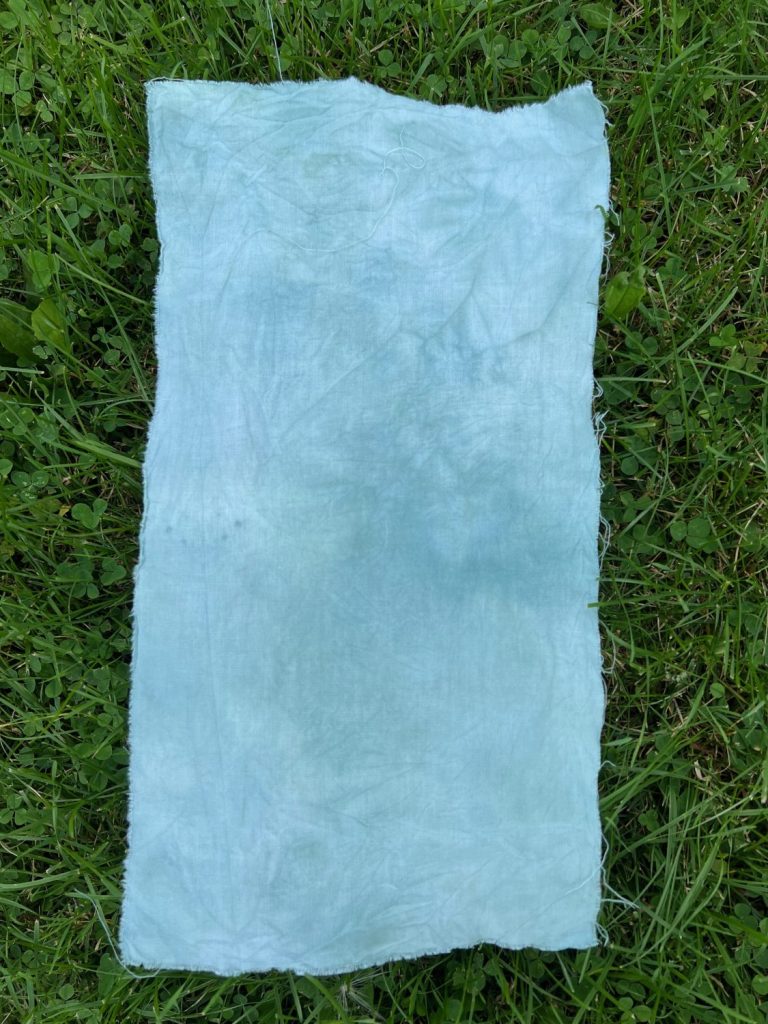
The piece of cotton I dyed today.
Before I left, I pulled out a handful of Sock’s wool from the bag and showed it to Susannah. Her eyes twinkled and her whole face smiled. It’s beautiful, she said, and remarked on the luster. Then she said she’d make sure I got some of it back after she cleaned and dyed it.
“I’m so glad that you will have it,” I told her. And I knew at that moment it was what I had been saving Socks’ wool for.
Stephanie dipping a cotton skirt in the indigo dye vat
I was the first one to arrive at Stephanies house. Even though I’d never been there before, I knew when I knocked on the front door and there was no answer to go to the back yard.
Stephanie was already working, wearing a floor length apron and rubber gloves up to her elbows, dipping a damp cotton skirt into the vat of natural indigo dye.
Next to the vat was another tub of water for rinsing the fabric. Between two maples, was a makeshift clothes line, the ropes held up by six or seven tall forked branches.
Stephanie had emailed me early in the week asking if I’d like to share her indigo dye vat. I didn’t hesitate, writing back asking where and what time.
The fabric turns green in the dye vat. It’s only when it hit the air and oxidizes that it turns blue.
I had with me the things Stephanie told me I’d need. Rubber gloves, junky clothes, a peanut butter and jelly sandwich with two small apples and a stack of white vintage hankies trimmed in lace.
We got right to work. Stephanie’s years of teaching weaving and dyeing was evident in the way she casually and clearly instructed me what to do. I was a bit familiar with natural dyeing from the workshop I took with Stephanie and Suzanna last summer.
But today was different.
Stephanie dyes with natural indigo about two times a year. When she does she often invites other women to join her. Being invited felt like a privilege to me. I was eager to work, learn and be a part of tradition that humans have been doing for thousands of years.
Stephanie was expecting a few more people to arrive but she wasn’t waiting for anyone. I helped her hang some of the garments and fabric she had rinsed after three minutes in the dye vat.
Then I soaked the hankies I’d folded and tied with rubberbands, my own version of Shibori, (the Japanese art of tying, stitching, folding and dyeing fabric) in a smaller bucket. I didn’t stop soaking, rinsing, hanging them on the line and repeating the process five or six times till the end of the day.
At some point Stephanie’s neighbors were walking their dogs and came over to see what was going on.
Three generations of women, the youngest girls old enough to be interested in what we were doing. Stephanie invited them to bring a tee shirt over and dye it. She spent a good amount of time teaching one of the girls, who wanted to learn, how to dye her clothes to make them indigo blue.
Soon Adina, her three year old daughter and Susannah pulled into the driveway. I knew them all, along with Stephanie, from the Community Weaving Project last summer. That’s when I, along with anyone else who wanted to, got to weave a rag rug on Stephanie’s three hundred year old loom.
Adina had some clothing to dye and her daughter sat and played by herself the whole time. I was impressed by her ability to entertain herself.
Stephanie hanging her dyed fabric on the line.
At one point I sat on the grass in front of Susannah who had a basket of wool balls and a bowl of soapy water in her lap. She was felting the naturally dyed balls that would become the heads of her puppets. Like Stephanie, Susannah has been weaving and using natural dyes for many years.
Susannah and I started talking sheep and she told me how she first got sheep because she was curious about the references to them in the bible.
She talked about how smart sheep are, despite their reputation of only being followers, how they each play a different roll in the flock, and how they look to the shepherd for guidance. I wanted to hear Susannah’s stories.
A shepherd like myself, I found we had the similar feeling and insights about our sheep.
Stephanie cutting the strings she sewed to create a Shibori design on a shirt.
Stephanie’s sister Micky was the last to show up. She had a bin filled with linens, but also shirts that she used Shibori dyeing techniques on to create unique clothing.
While Stephanie and I hung one of the old sheets that she had dyed and would eventually use in her woven rag rugs, I asked her why she invited people to share her dye vats with her.
She told me she liked to be around women who had a love of fiber and fabrics.
I know just what she means.
Working with fiber, whether its wool, linen, the milkweed that Adina combines with llama’s wool and hand spins, or repurposed fabric to be made into rag rugs and quilts, is ancient and holistic. Especially when it involves caring for the animals and plants that are the source of the fiber, which eventually become the clothes we wear, the blankets we cover ourselves with and the rugs we walk on.
The work itself and working together is what makes a day like yesterday special.
And of course the people. Stephanie had invited us to be there, but when the kids from next door showed up she was happy to have them join in.
As the day was ending the girls came back. This time they were playing around the clothesline, doing cartwheels under the indigo dyed sheets and linens hanging there.
The dyed Shibori design on the shirt after the strings are cut
As I helped Stephanie clean up at the end of the day, she showed me her weaving studio in the attic of the barn. A magical space filled with floor looms, fibers and fabrics.
I left Stephanies with my bag filled with a stack of indigo dyed vintage hankies, yellow rubber gloves turned blue, and two apple cores. Stephanie and Micky gave me a hug in the driveway.
“My indigo friends,” I said them.
Then I walked towards town where I would meet up with Jon so he could drive us home. Smiling and sweaty from the day, clothes and hands stained blue with indigo.
Susannah pulling wool roving from a dye bath of fustic wood shavings.
Susannah’s joy was infectious as the pulled the wool roving from the dye bath. She and Stephanie were teaching the workshop on dyeing with natural plants at the Cambridge Historical Society on Saturday.
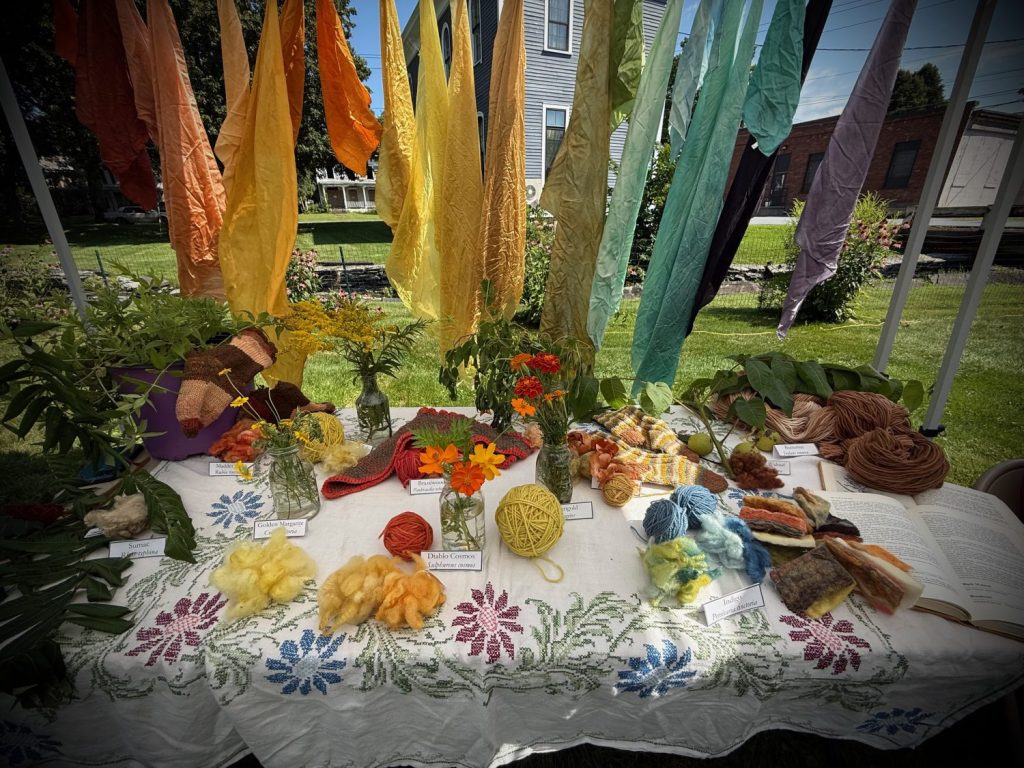
Susannah’s plant dye samples. And Stephanie’s Indigo dye samples. Those are black walnuts on the table which Stephanie was using to dye some wool.
We learned that most plants, no matter their color, will make a dye that is a variation of yellows, tans, and browns. Indigo makes blue and a few plants such as Brazilwood, Madder and Woad make a red dye.
Susannah and Stephanie with the jars of Indigo Dye and a dye bath of Woad on the stove.
Stephanie had two jars of Indigo dye. There was a good crowd at the demonstration and each one of us accordion folded a cotton hankie then wrapped the ends with rubber bands. Stephanie was teaching the Japanese dyeing technique of Shibori.
That’s one of my hankies coming out of the Indigo dye in the photo above. It’s green until it hits the air and oxidizes, then it turns blue.
I brought some of the white hankies, that so many of you have given me over the years, and dyed them with Indigo. I had to boil them in water and Dawn dish soap to remove the dirt and starch from the before dying.
Preparing the linen and cotton this way is called Mordanting. It’s usually done with alum and or cream of tarter, but for my purposes the Dawn worked fine.
The hankie on the left was drying on the line for about 15 minutes after being dyed with Indigo. The one on the right is the same hankie in the photo above this one. You can see how it is changing color. We dyed the hankies three times.
To set the dye I still need to wash the hankies in Ivory soap and hot water, again and again until the dye stops leaching out of the fabric.
Stephanie also dyed some roving using marigold flowers. I loved the color and have lots of marigolds in the garden this year. They are actually one of the few flowers that did really well.
There was a lot of information through out the day including the history of dying and fibers, I’ve only touched on the smallest bit of it. At one point I was standing next to my friend Ute and looked at her and said, “There’s not fucking way I’m going to be able to do this.”
But at the end of the day, I felt like I had grasped some of the the basic information and having had some practical experience, I thought I might try dyeing some of my linens with marigolds.
Some of the Shibori hankies and my hankies drying on the line.
When I first heard that there was going to be a Natural plant dyeing demonstration I wasn’t planning on going. I was feeling that I have enough going on and adding plant dyeing, which takes years and years to learn to do properly, seemed like too much to take on.
But working with Susannah and Stephanie on the Community Weaving Project made made me curious about dyeing. They are also both good and generous teachers and when Stephanie offered to let me dye some of my hankies, I could hardly resist. I wanted to see what they would look like using natural Indigo dye.
Now I’m so glad I went. Not only did I learn a lot and think I might try some natural plant dyeing on my own (or even better with my friend Ute), but I met a lot of nice people and it was just an enjoyable afternoon.
All of us with our Shibori hankies dyed in Natural Indigo. All the hankies were folded and tied in the same way, yet they all came out different.
“…as I was looking at your new hanki-quilt that the words “January Thaw” kept coming to mind. I think the faded blue and white colors were reminding me of the melting ice- very pretty.”
That’s a message Esther sent me in an email. And I couldn’t agree with her more. I’ve been seeing my shibori designs and colors all around me in the ice, shadows, and snow.
I’m not sure if it’s the winter colors that inspired me to do the Indigo Shibor dyeing, or if I’m seeing the world around me differently because of it. But I’m not surprised. Everything I make is influenced by my perception of my surroundings.
I worked at the Co-op today but was able to do a little bit of work on my Shibori Hankie Quilt this morning. I’ll continue the brighter blue around the darker.Marks in the snow made by a bird’s feet and wing, remind me of the Shibori designs.Feather frost on the window also made me think of the Shibor designs and colors