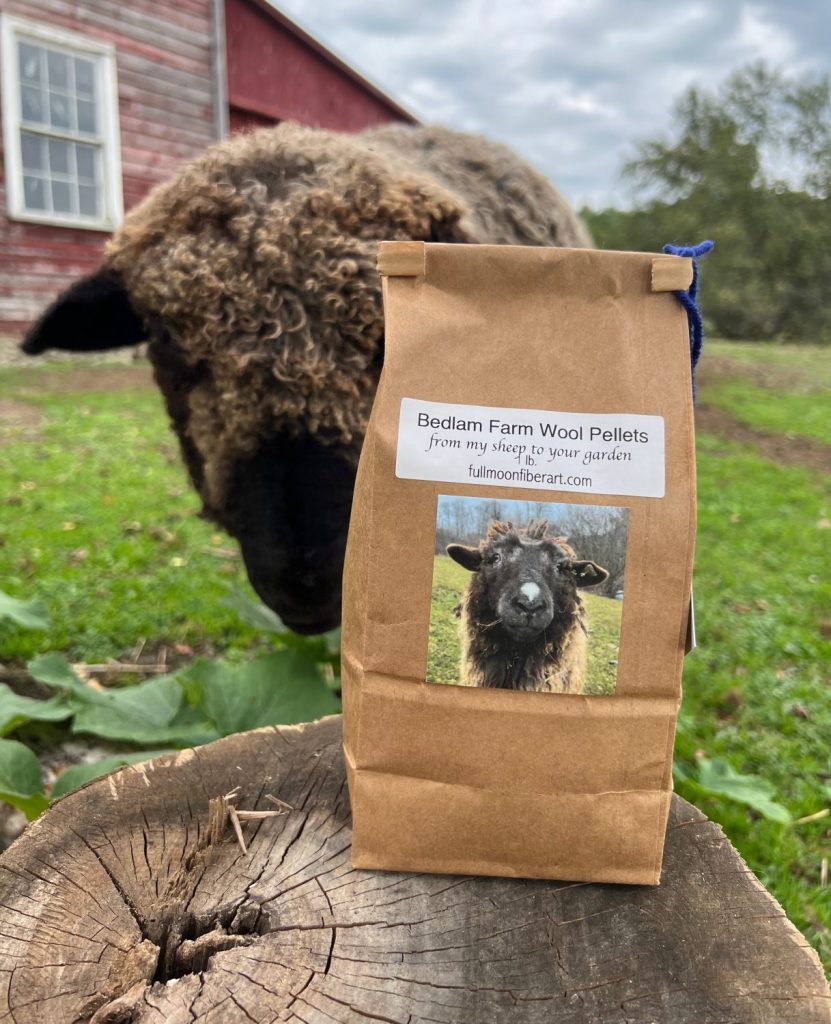
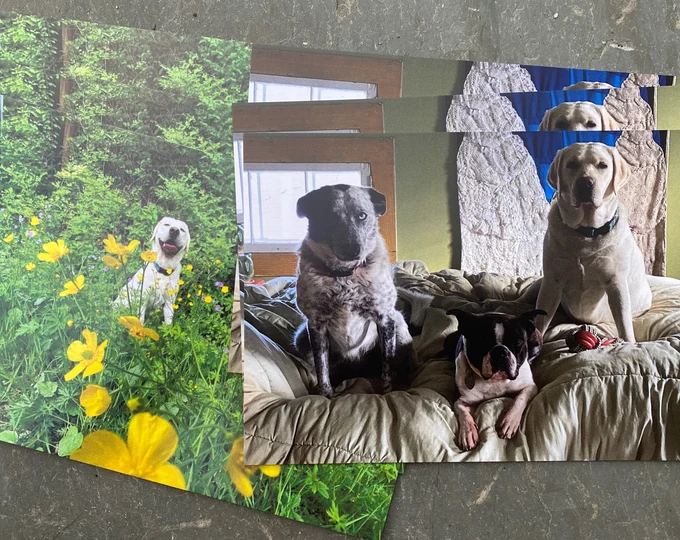
My Bedlam Farm Wool Pellets, for the garden, were delivered this weekend. I’ll write about them more this coming week, but I just wanted to let you all know I now have some for sale again. ( You can read about my Wool Pellets here)
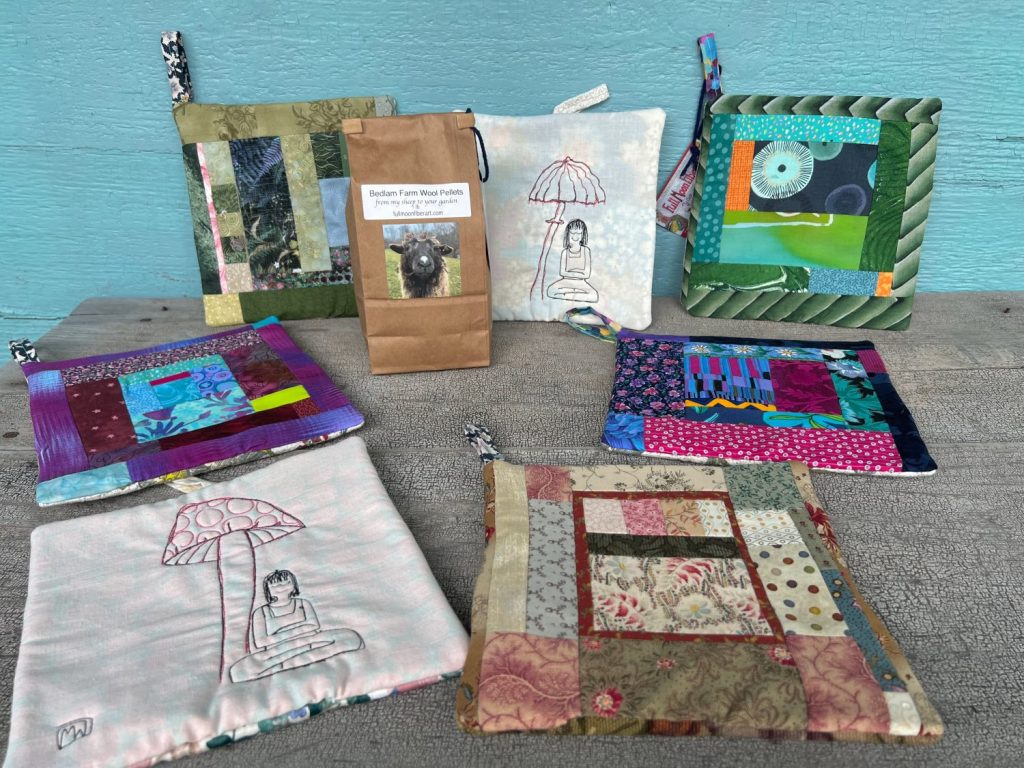
I still have some Potholders available too, along with my magnets.
You can see them all and buy them in my Etsy Shop, just click here.
Robin checking out this years Wool Pellets. That’s his mother Lori on the bag. (Robin was on the bag last year)
The sheep are spending the days in the pole barn. The sun is hot and the gnats and mosquitos are relentless. Even if I left the gates open all day they would wait until it got dark to graze.
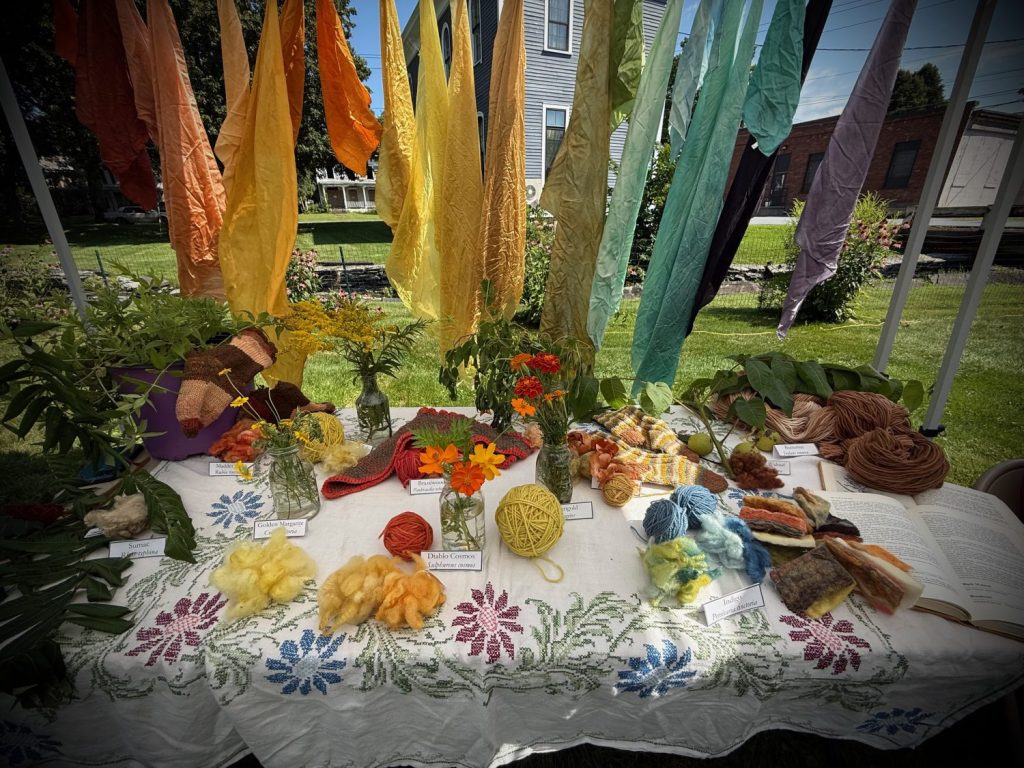
Susannah’s Natural Dyeing Display at the Cambridge Farmers Market
I saw Adina and her spinning wheel as soon as we got to the Farmer’s Market. The tent was like a magnet pulling at me.
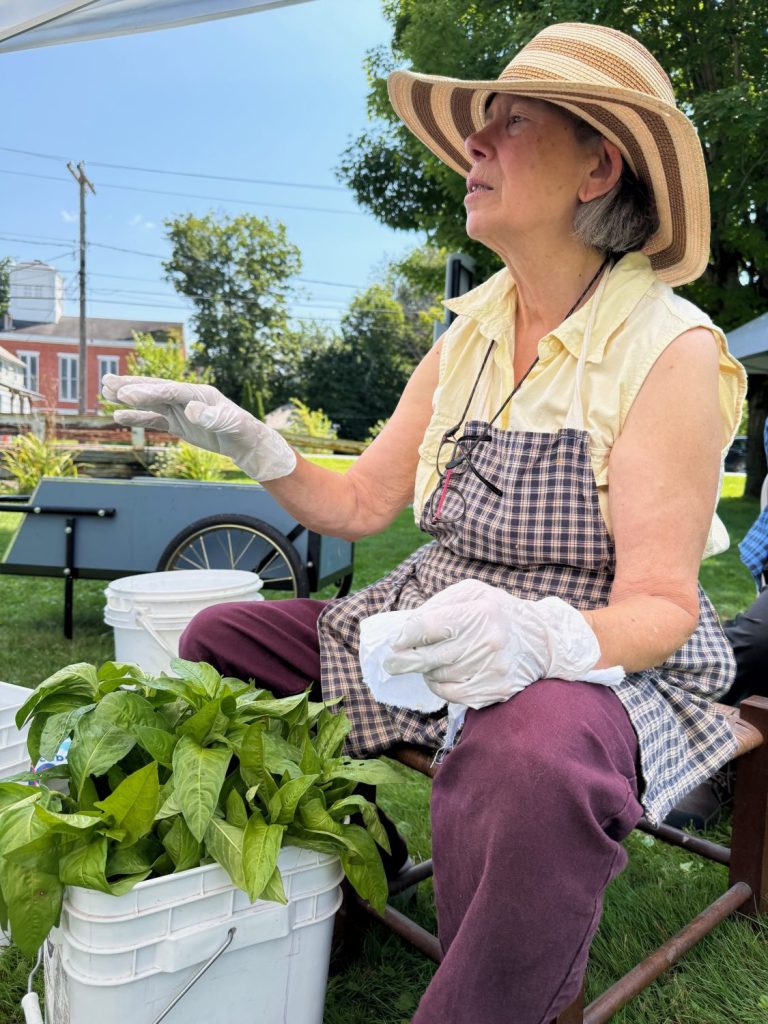
Susannah White, was sitting on a low bench with a bucket of freshly cut indigo plants next to her. She had picked them from her garden that morning.
I’ve been thinking of Susannah since I met her again at Stephanie Morton’s house a few weeks ago where we were dying with Indigo. Stephanie dyes with dried indigo, which is different than dying with fresh indigo which Susannah was doing today.
That weekend Susannah and I talked sheep. Although Susannah no longer has sheep, she still works with wool, specifically Border Leicester. She hand cleans and cards it, dyes it naturally, and felts it to make into puppets.
When Susannah told me how she loves the sheen of Border Leicester wool, I thought of the bag of wool I have from my ewe Socks. Socks died just before shearing and her wool was so beautiful, I cut some off of her before putting her body in the field for other animals to eat.
Susannah and her home grown indigo in a bucket of ice water to help keep it from oxidizing.
So I went home and came back with the bag of Socks’ wool to give to Susannah.
When I got there, the tent was full of kids and their parents rolling a small piece of cotton fabric, filled with indigo leaves, between their hands.
I got a piece of cotton fabric and joined them.
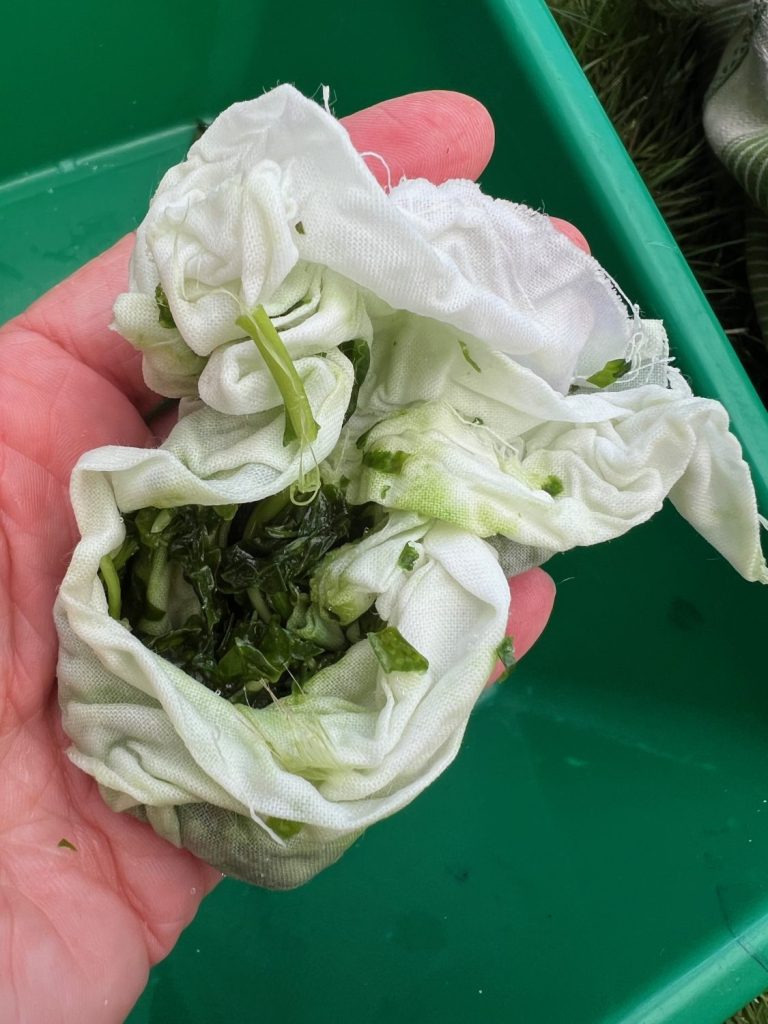
The indigo leaves in my cotton cloth
The cells of the indigo leaves are filled with two different chemicals (? I’m not sure that’s the right word) and the two different cells have to be broken and mixed together to create the indigo color dye.
First we twisted the leaves, the then broke them into small pieces. We put the pieces into the wet cloth, added a little salt to speed the process up, and rolled and squeezed them in our hands and watched the white cloth turn green.
There is little consistency dying this way. Each leaf may produce a different color. The color also depends on how well the plants grew. This spring and summer were difficult ones for indigo, with widely varying temperatures, then a period of intense heat.
As soon as the plants are cut they begin to oxidize and turn indigo blue. Unless you put them in ice water which slows the process. If the plants turn blue before they come in contact with the fabric, the dye won’t work.
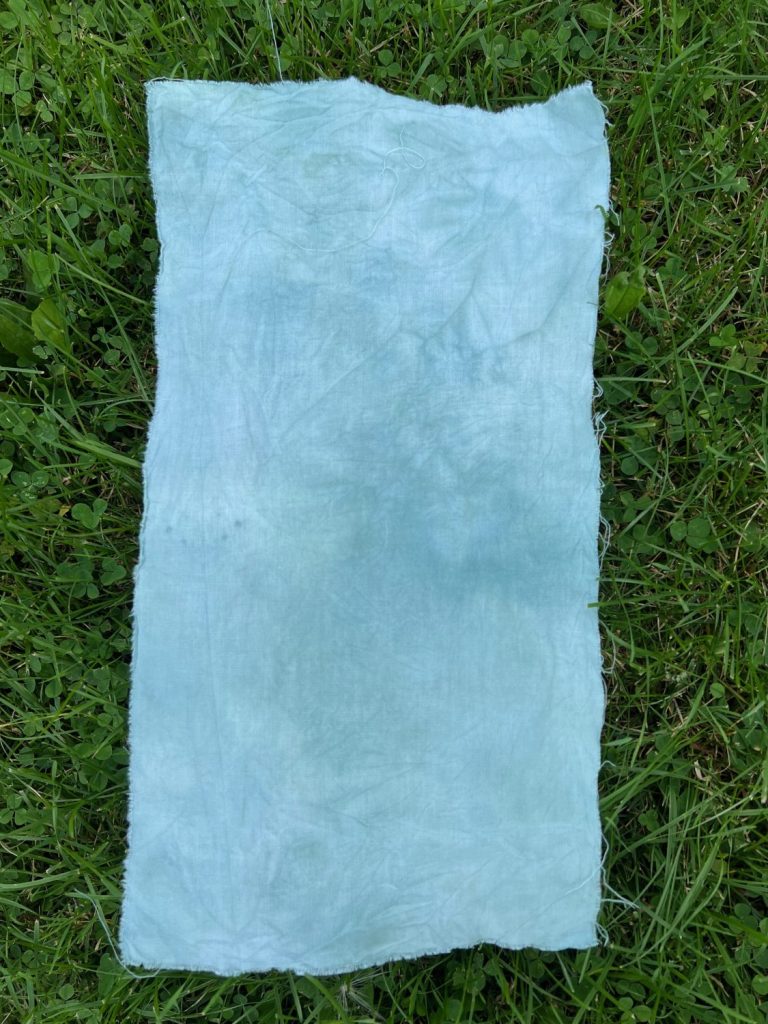
Each piece of fabric was a different color depending on the leaves, how much pressure we applied and how long we worked it.
Susannah not only knows all about natural fibers and dyes, she knows and shares the history of it.
There are lots of varieties of indigo plants. The ones Susannah grows originally came from Africa. In the United States, the knowledge as well as the labor of growing and processing Indigo into dye, came from enslaved African’s. For many years it was one of the country’s largest export.
The piece of cotton I dyed today.
Before I left, I pulled out a handful of Sock’s wool from the bag and showed it to Susannah. Her eyes twinkled and her whole face smiled. It’s beautiful, she said, and remarked on the luster. Then she said she’d make sure I got some of it back after she cleaned and dyed it.
“I’m so glad that you will have it,” I told her. And I knew at that moment it was what I had been saving Socks’ wool for.
I watch Kim hold up her bad leg, the one opposite turned in from the imbalance. I wonder about how much pain she’s in. If it’s wrong, as old as she is, to make her go through another winter.
Then I see her big belly full of summer grass. I see the way she lets me know that she wants more grain, even though she obviously doesn’t need it. I see how even if she sometimes is slower than the other sheep, she never hesitates to follow them into the pasture to graze. And how she stands next to Asher or Issachar when Robin tries to butt her, how they protect her.
Kim looks at me with determination and will.
It’s all these things that tell me that she’s not ready to leave the world just yet.
The sheep lower their heads into corners and behind gates, they shake their legs and stamp their feet at the flies, their wool quivers with their breathing, as if driven by a small engine.
The sheep spend their day in the shade of the pole barn, by the afternoon it’s filled with manure and piss.
I muck out the manure and throw wood chips in the puddle of piss to absorb the moisture.
Lori squats and creates a long stream of urine, refilling the puddle.
The sheep are restless, they lay down and get up again, walk from one side of the barn to the other dropping manure where I just cleaned, as they go.
Kim holds her bad leg off the ground.
I know she’s waiting for us to leave before she lays down.
She’s the only animal on the farm afraid of Zinnia. Probably because, unlike the other sheep, when Zinnia chases her, she runs so Zinnia get excited and chases her more.
Maybe when the dogs and I leave the sheep will settle, I think.
I call the dogs and leave the barnyard.
Sometimes it better for the sheep when the shepherd isn’t there.
Merricat, head up ears forward with Lori, Asher and Fate (that’s Issachar and Constance behind them.)
“There were countless sheep hunkered in the crook of the house. They were all looking in different directions, skulls empty of care or concern. All except for Ishbel. Ishbel had her inquisitive black face raised above the matted sea of ecru fleece. The cull ewe was staring up at the windows as though she was listening to them talk “I don’t get around much, so wee Ishbel keeps a watch on things, she lets me know what’s happening up the road.” … wee Ishbel is the new bellwether.”
“Impossible,” he said. “A bellwether is always a castrated ram. It’s there in the name.” From John of John by Douglas Stuart
I’m familiar with the word bellwether, as an indication of the whats to come, but I’ve never thought about its origins, or about it in relation to sheep.
Traditionally the bellwether wears a bell around his neck so the flock could be more easily tracked by the shepherd. Because wherever he is, the rest of the flock will be too.
When I read about Ishbel, in Douglas Stuart book John of John, I loved the idea of the sheep who keeps an eye on things. There is something mystical about Ishbel and I immediately thought of one of my first ewes, Zelda, who I have no doubt was the bellwether while she was alive.
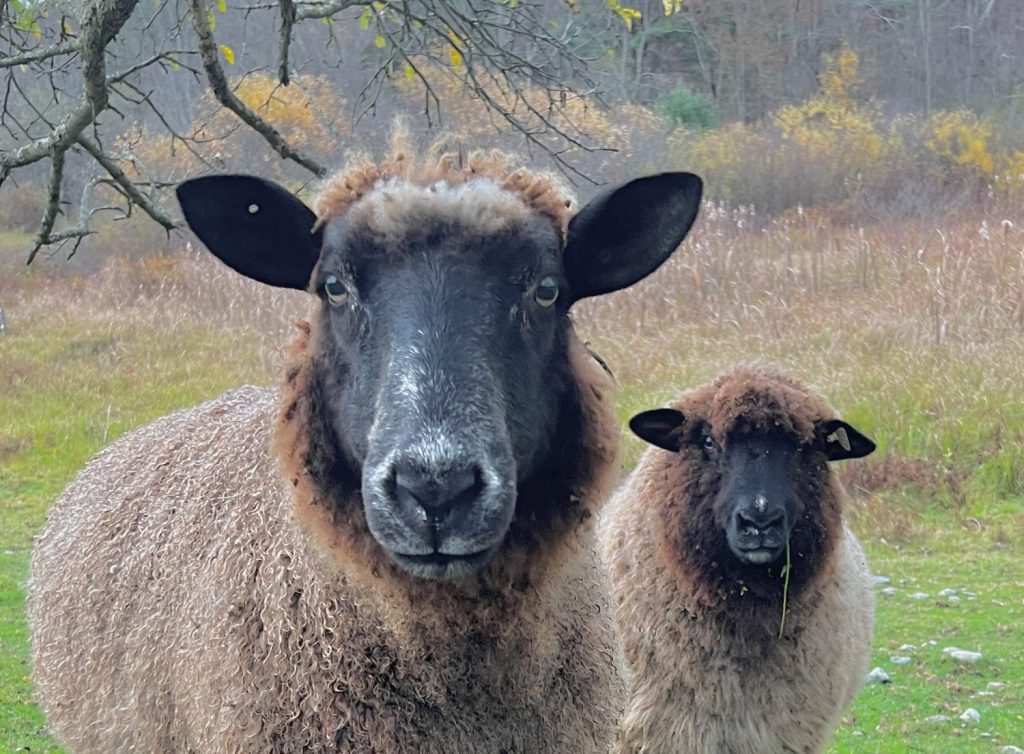
When I thought of the sheep I have now, I considered the twins Asher and Issachar, but then I thought of Merricat. I think Asher and Issachar are the leaders of the flock in some ways, they keep the peace, breaking up head butting and protecting the older sheep like Kim.
But it’s Merricat that I often see looking out, as if scanning the the world around her as the other sheep are busy grazing or chewing their cud.
It also makes me think about how Merricat will sometimes come up to me and put her face right in mine, seemingly smelling the air coming in and out of me. And I have at times felt like she was trying to tell me something, once even how to empty my mind as a sheep might.
As Ella, from Stuart’s novels says, she “Keeps a watch on things….lets me know what’s happening”
Zelda
(Jon and I always give our books away, but this one I’m keeping, for a while anyway. It’s stuck in my head or I’m stuck in it. It’s about the relationship between a father and son, about isolation even when surrounded by people, but also about sheep and weaving on the Isle of Harris.)